AnkiWeb
- Votes
- 0 (👍 0 · 👎 0)
- Updated
- 2026-10-30
- Anki versions
- 26.09.3~
- Languages
- Python, JavaScript, JSON
- Description language
- en
AnkiWeb addon 237872806
Builds a parallel extra-review queue in one click during reviews, letting cards reappear after a chosen interval independently of Anki/FSRS scheduling, with green badges showing ready practice.
Open on AnkiWeb GitHub Ask about alternatives
active
| Min Anki | Max Anki | Updated |
|---|---|---|
| 26.09 | 26.09.3+ | 2026-10-30 |
Loading…
Opens the first due card of a selected deck at launch and automatically advances through a queue of decks after each one is finished.
Adds browser buttons to move selected new cards into the learning queue, grade cards directly, and reset selected cards to new.
Orders review cards in regular decks by interval, default decreasing or optionally increasing, though it can slow queue building.
Provides a one-time, roughly 60-second encoding routine for new vocabulary before review, applying scientifically supported techniques to build deeper initial memory and improve retention.
Generates natural flashcard audio with four free online and offline text-to-speech engines, parallel processing, multi-language workflows, presets, and pitch, speed, and volume controls.
Generates AI hints and multiple-choice options for flashcards during review, with multi-provider fallback, batch generation, inline editing, undo, and mobile support.
I've found HoldUp indispensable in my own Anki routine. If you like simple, minimalist tools, you might like it too.
HoldUp — Build your own extra review queue in one click
HoldUp builds a parallel review queue on the fly, separate from your normal Anki/FSRS schedule.
Version 1.0.0 — free and open source.

The little green badge means there's HoldUp practice ready in that deck. Open the deck as usual to study it.
Under the hood, it's dead simple: set your interval once, then hit HoldUp to add an extra appearance of the card to your own queue. Rate the original normally — Again, Hard, Good or Easy — letting Anki/FSRS schedule its usual interval, say, two days. Adding a HoldUp appearance doesn't answer or reschedule the original.
Wanting a quick re-check tonight doesn't mean I'm unhappy with the algorithm. For example, I might remember a kanji perfectly fine and be totally okay with a two-day gap, but still have this random urge to double-check one of its components or radicals tonight, just to be safe…
This add-on lets you scratch that itch right away. With your interval already set, queue up that extra review in one click, keep your flow, and move on. When it's ready, it joins the green review count and shows up when you study that deck.
Sure, you could put together something similar with flags or filtered decks. For me, that setup gets in the way. I wanted to build that parallel queue directly during reviews without stopping to organise it manually.
It's not meant to improve FSRS predictions… it's just a fast shortcut for optional extra practice.
Extra practice doesn't submit FSRS ratings, so FSRS doesn't know about those extra looks. They can still affect what you remember at your next normal review.
How it works, step by step
These screenshots show Japanese sentence cards. HoldUp can also be used with other subjects.
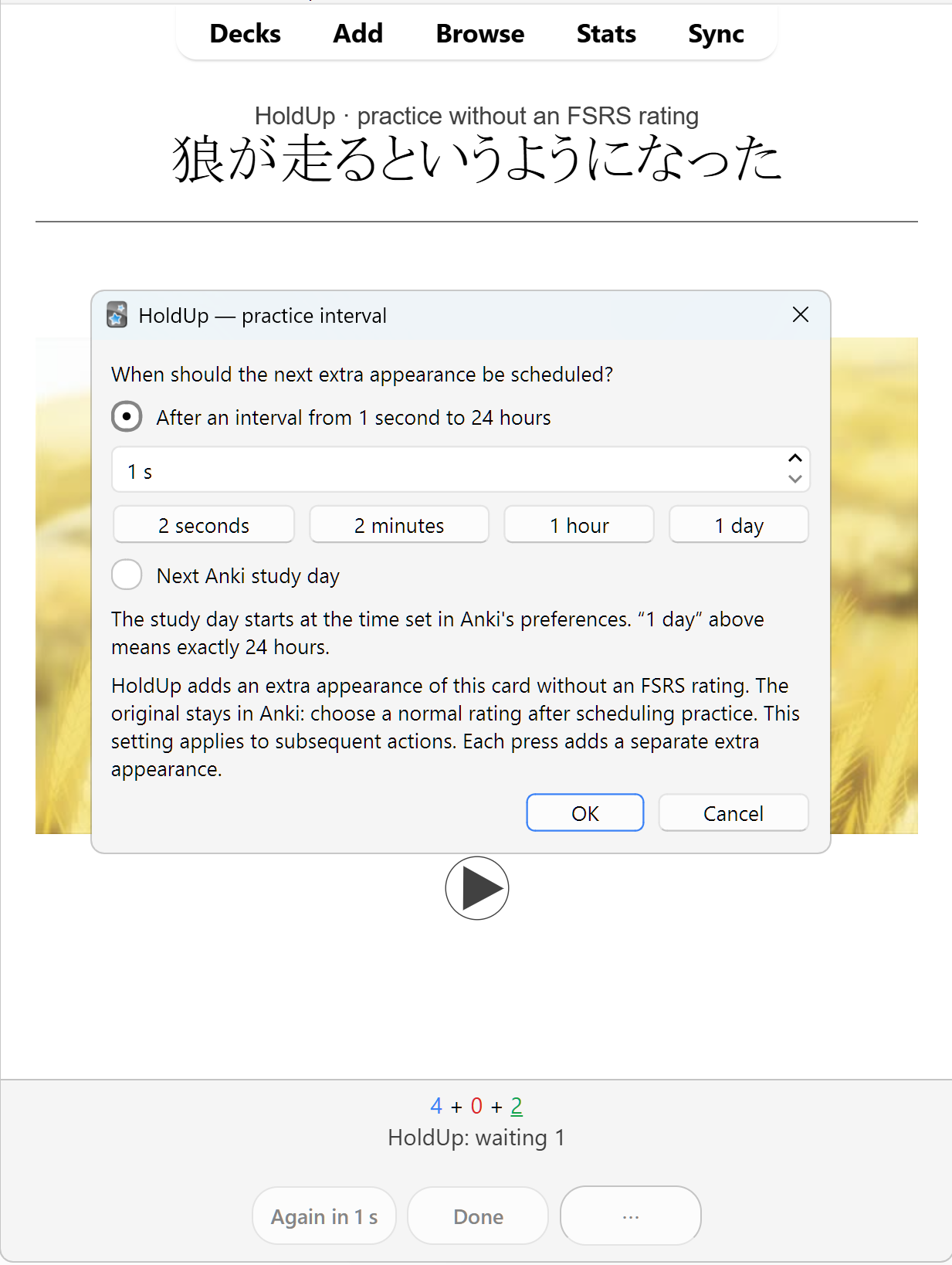
1. Choose when you want another look
Use the … menu to choose 1 second to 24 hours, or Next Anki study day using Anki's day-start setting. This setting applies to subsequent HoldUp presses. The screenshots use a short interval to demonstrate the flow.
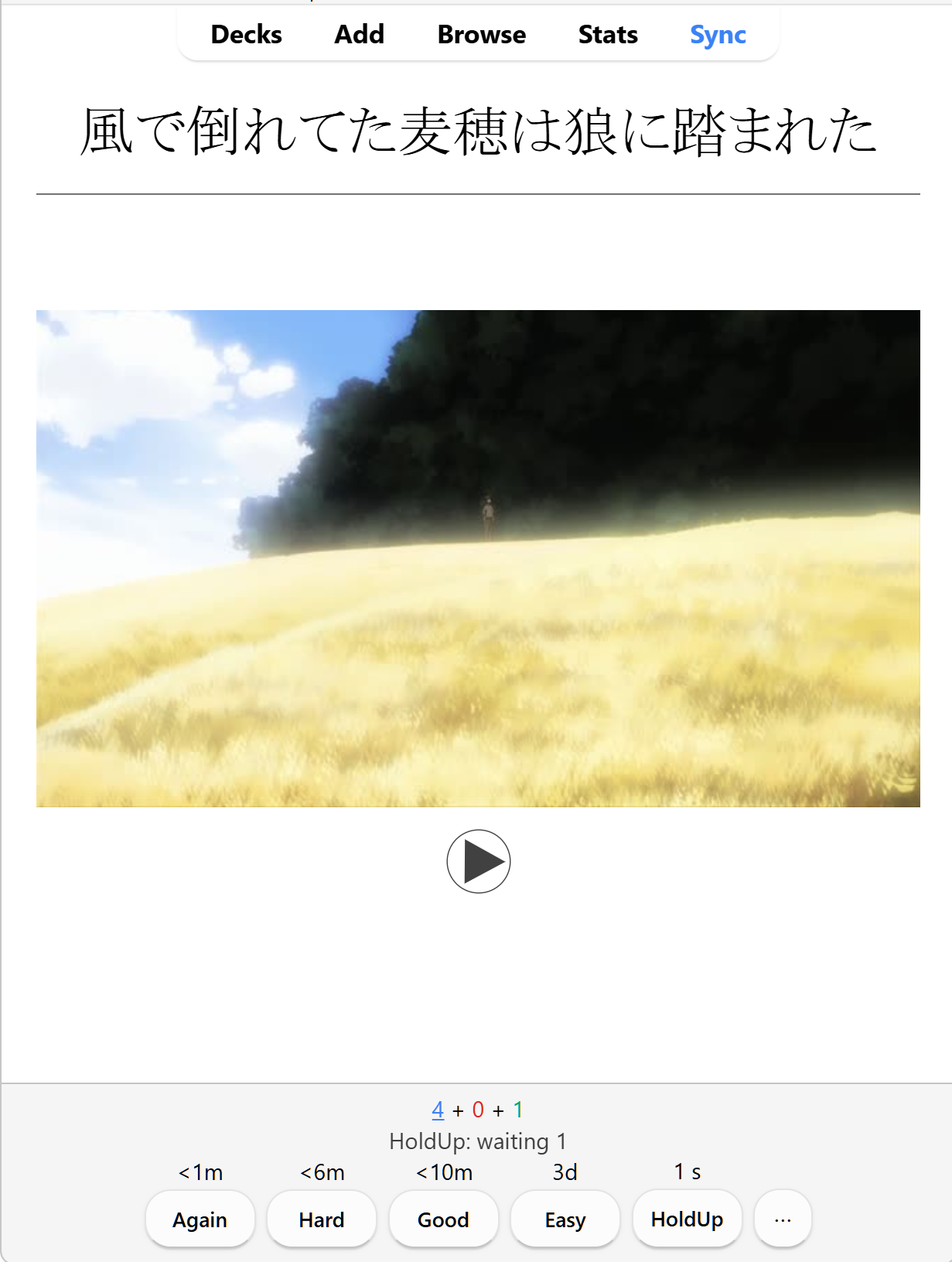
2. Show the answer and press HoldUp
Schedule an extra appearance of the card at your chosen interval.
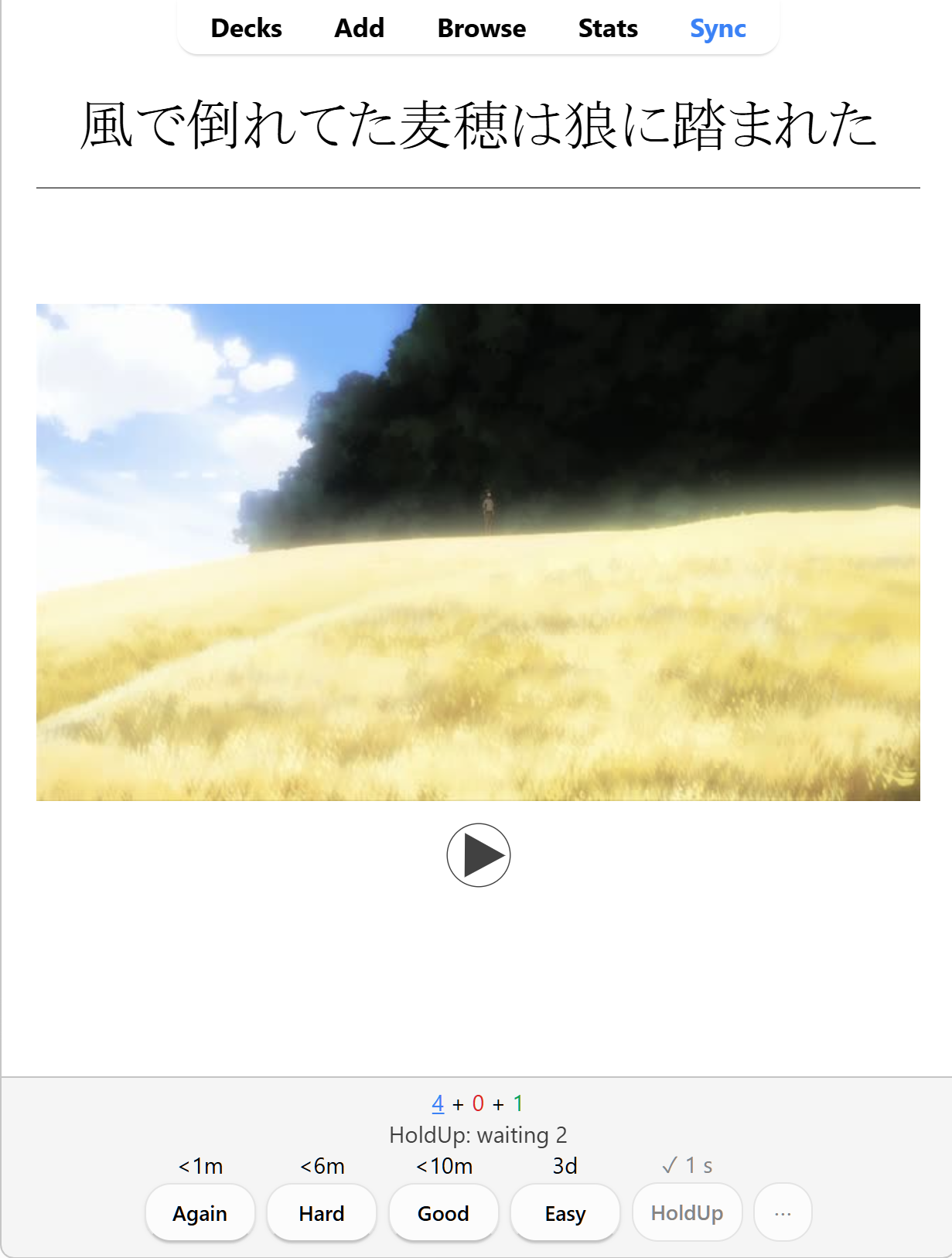
3. Choose your normal Anki rating
The checkmark and increased waiting count confirm that extra practice is scheduled. The original stays open: choose Again, Hard, Good or Easy to finish grading it as usual.
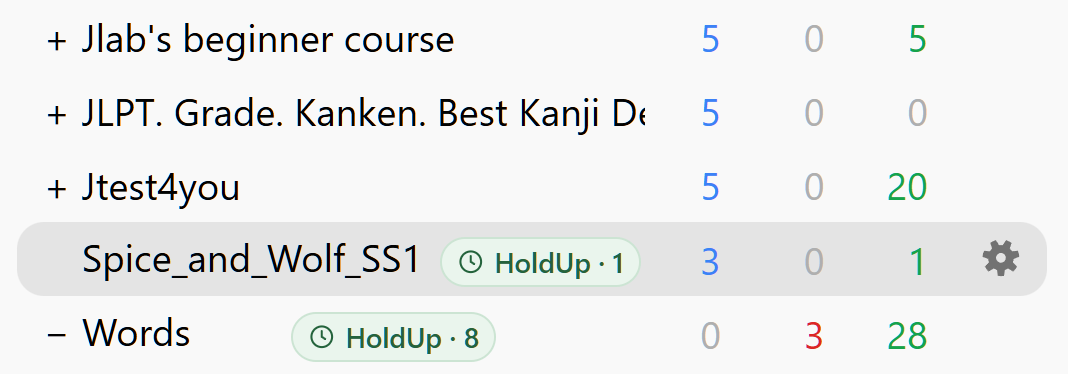
4. See when extra practice is ready
When its time arrives, a green clock badge appears next to the deck name on the Decks screen. It counts ready HoldUp appearances; the native Anki counts remain visible alongside it.
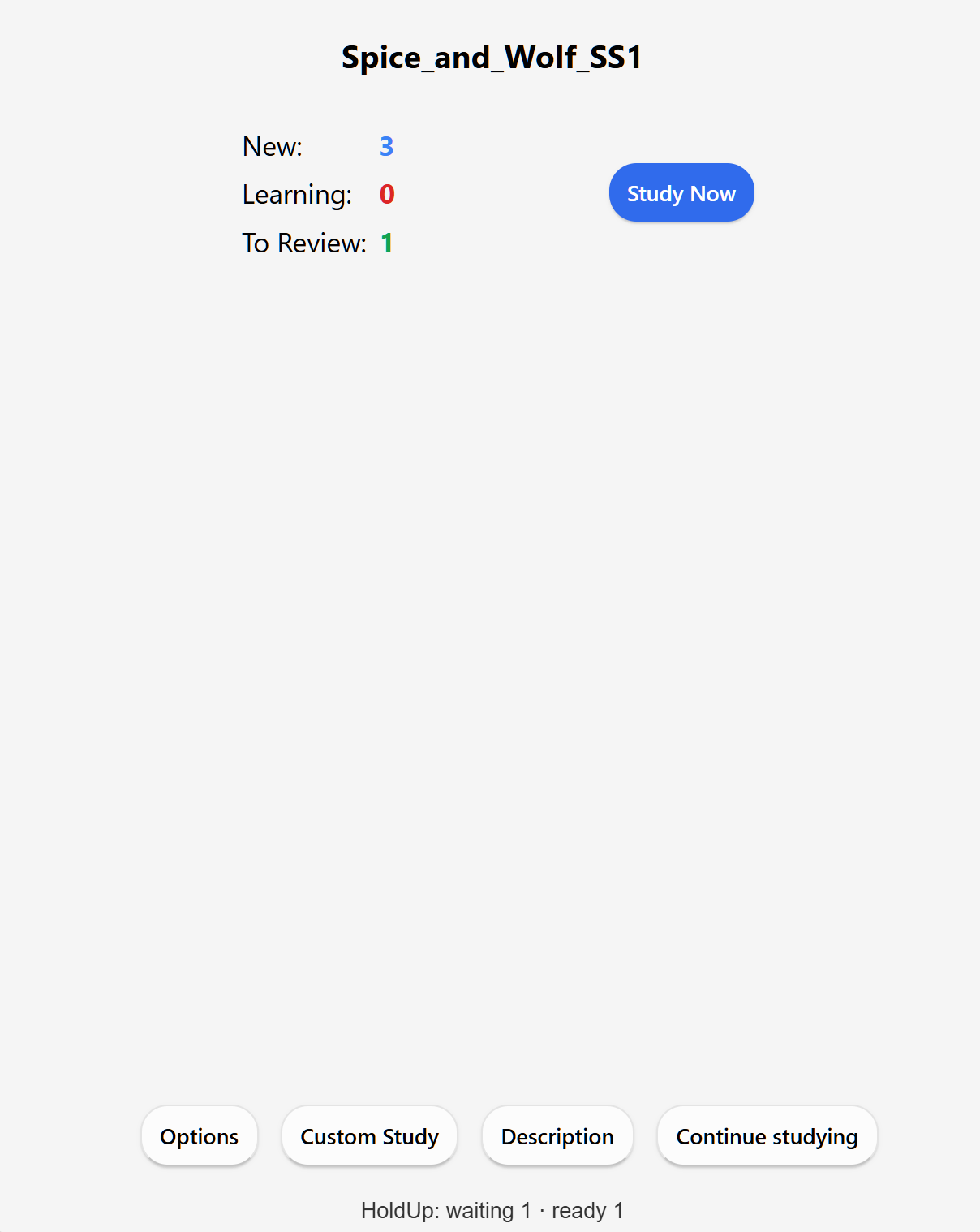
5. Open the deck and continue studying
The deck overview shows both waiting and ready appearances, with ready practice included in the green review count. Continue studying returns to the same reviewer.
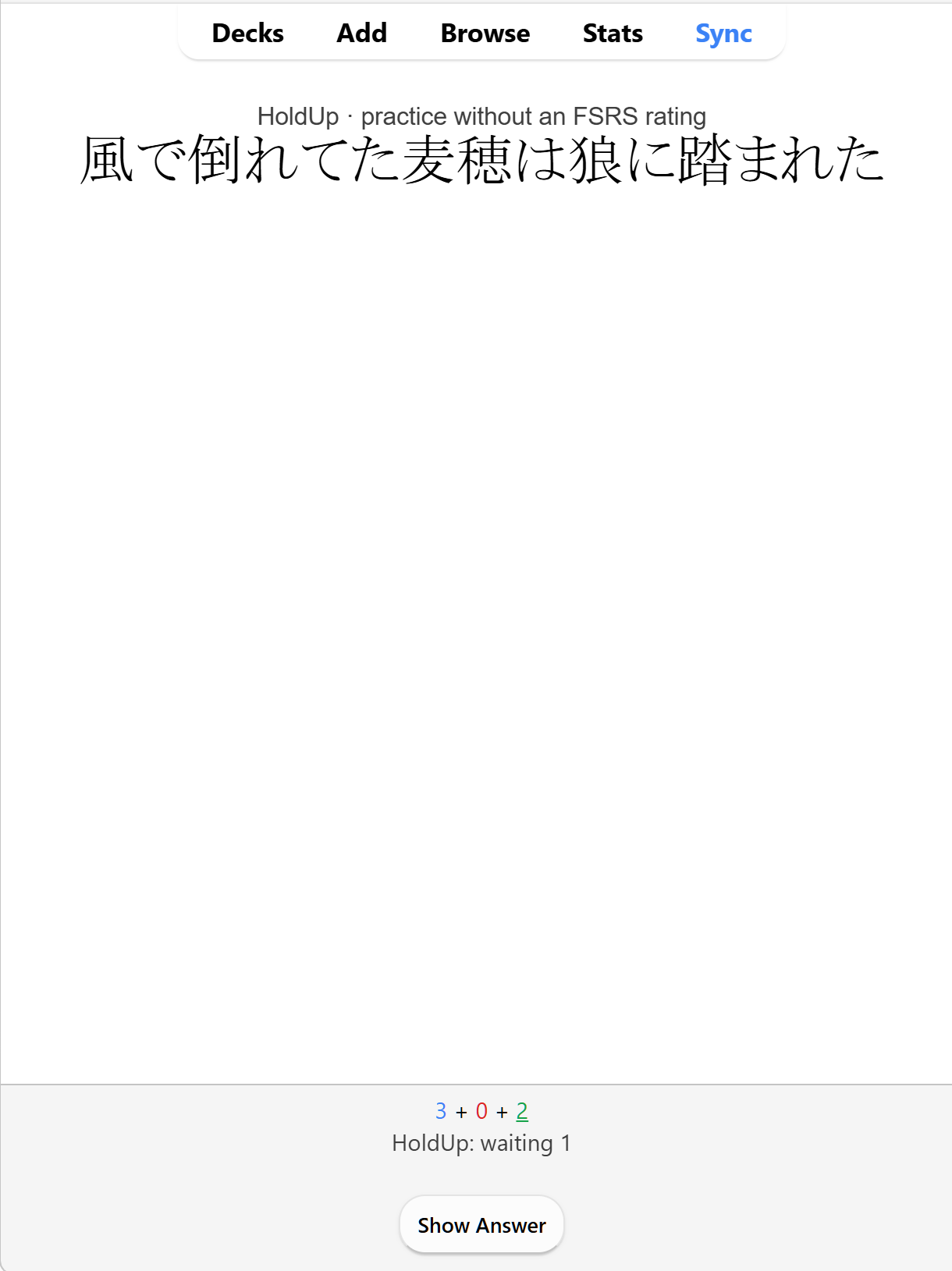
6. The card returns for extra practice
Ready appearances join the same reviewer. The HoldUp label identifies practice without an FSRS rating. Press Show Answer as usual.
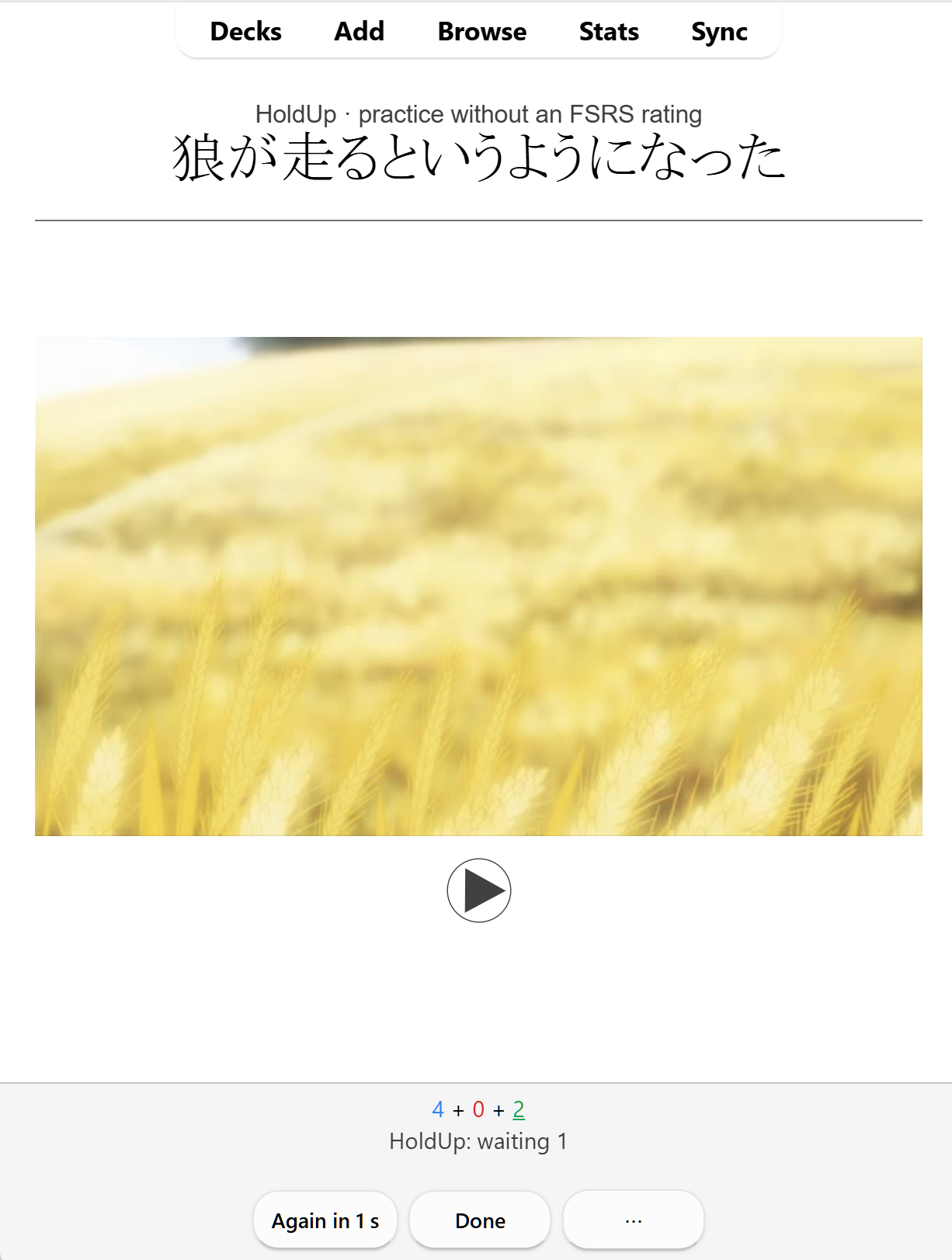
7. Repeat or finish this extra appearance
Again in… reschedules only this appearance; Done finishes it. These actions do not submit a normal FSRS rating.
A few more details
Your normal Anki rating handles the original card's schedule, FSRS history and daily new-card accounting.
Tested compatibility: desktop Anki 26.09 and 26.09.3 on Windows and Linux. macOS has not been verified. First-release support is one desktop installation per collection. Full collection exports and Anki backups preserve the extra queue; deck .apkg export does not transfer the complete queue. Live multi-device sync/conflict resolution is unverified. AnkiDroid and AnkiMobile do not run desktop Python add-ons.
User guide · Русская инструкция · Validation · Report a bug
Open source under AGPL-3.0-or-later. Source code
Feed the developer
If HoldUp helps you, you can buy me a snack. I like food. Thank you 🍀
The add-on is completely free. Support is optional.
I also plan to make Anki decks based on web novels, regardless of donations. You can leave a web novel title or an idea for a future deck in your DonatePay or Boosty message. Your suggestions may help me choose which novel to work on next.
English · Русский
I've found HoldUp indispensable in my own Anki routine. If you enjoy simple, minimalist tools, I think you might really like it too.
You know the kanji and its meaning. A normal review in two days is fine — but you still want another look tonight, maybe to check one of its components.
That's what I made HoldUp for. Choose your interval once, then press HoldUp while reviewing to add an extra appearance to its own queue. Rate the original as usual and carry on. Ready appearances join the green review count and show up when you study that deck.
You can put together something similar with flags or filtered decks. I wanted to build that parallel queue on the fly, without stopping to organise it manually.
Pressing HoldUp doesn't answer or reschedule the original; your normal rating still does that. Extra practice doesn't submit FSRS ratings, so FSRS doesn't know about those extra looks. They can still affect later recall.
User guide · Руководство пользователя
Stable release 1.0.0. The owner reported completing the manual checks after approximately a week of use on 30 October 2026. Validation record · GitHub checks.
If another copy of this add-on is installed, disable it in Tools → Add-ons and restart Anki first. Then install the downloaded archive through Tools → Add-ons → Install from file and restart Anki.
Existing cards and practice appointments remain in the collection. Choose your preferred interval again if needed; local add-on preferences are not automatically copied from another installation. Keep only one copy enabled.
Python does not need to be installed separately. Start with a separate test profile.
Each HoldUp press adds an independent extra appearance. Earlier appointments keep their deadlines; the waiting count includes every appearance, even of the same card. No card or note is duplicated. Scheduling practice alone does not answer Good or consume the daily new-card allowance; the normal rating does.

After pressing HoldUp, the checkmark confirms the extra appearance. The original stays open so you can choose a normal Anki rating.

The interface follows Anki's language: Russian for Russian, English for other languages. Both translations are included. Restart Anki after changing its language.
Choose time through ⋯ or Tools → HoldUp: interval…. Presets include 2 seconds, 2 minutes, 1 hour and 1 day; custom intervals range from 1 to 86400 seconds.
Settings apply to subsequent actions. Existing appointments keep their stored absolute deadlines, including after a change to Anki's day-start setting.
During study, the green count includes ready practice. Its tooltip shows the Anki and HoldUp portions. Blue and red remain Anki's counts. HoldUp: waiting N shows future appointments as passive text.
On Decks, a small green clock badge HoldUp · N shows ready practice, even when the three native deck counts are zero. Open the deck by its normal name. Parents include their subdecks, including collapsed ones; parent and child counts overlap. Future and unavailable appointments do not show ready badges.

Practice uses the selected deck and subdecks. A deadline is the earliest time it can appear: the current answer and earlier native deadlines can delay it. When Anki is closed, appointments wait for your next session. Continue studying on the deck overview returns to the same reviewer when extra practice is ready.
Appointments, repeats, completion and clearing support Undo/Redo. After HoldUp → a normal rating → Undo, only that normal rating is cancelled: the original returns, and the HoldUp deadline remains. A second Undo cancels the earlier HoldUp appointment if no other collection action intervened. Undoing a practice repeat or Done affects only the practice appointment. Tools → HoldUp: clear all practice removes extra appointments across the open collection, including future ones. Cards and normal ratings remain.
Version 1.0.0 is the first stable release: faster large-queue clearing, AGPL-3.0-or-later licensing, reproducible packages and Windows/Linux CI. It retains independent appearances of the same card, their existing deadlines and native Undo/Redo.
First-release support is one desktop installation per collection. Full collection
exports (.colpkg) and Anki backups preserve appointments; deck .apkg exports do
not carry the complete queue. Live multi-device sync/conflict resolution remains
unverified. See the data contract.
HoldUp is free software under AGPL-3.0-or-later. The installer includes the runtime source, full license and project notice.
Release notes · GitHub releases.
Runtime has no dependencies beyond Anki. Source is in holdup/, and
i18n.py holds the English source strings and Russian translations.
python3 -m venv .venv
source .venv/bin/activate
python -m pip install -r requirements-dev.txt
mkdir -p .dev
python -m pytest -m "not anki_contract and not anki_gui" --basetemp=.dev/pytest-unit
For backend tests, install requirements-anki.txt. For desktop checks, use separate
environments with requirements-gui-26.09.txt or requirements-gui.txt.
Do not install both Anki versions into one environment. Run GUI suites sequentially
because Anki uses a single-instance mechanism.
python -m pytest --basetemp=.dev/pytest-full
python tools/package_addon.py
python tools/build_release.py --tag v1.0.0
The build is .dev/dist/holdup.ankiaddon. Published archives and checksums are in
dist. Tests use disposable collections and profiles without
AnkiWeb; pytest clears --basetemp. Skipped backend or GUI checks do not establish
integration support.
Architecture and manual checks are maintained in Russian. The owner completed the requested manual checks. Other Windows configurations, audio and complex templates can still vary; live cross-device sync remains outside the supported scope. AnkiDroid does not run desktop Python add-ons. Extra practice does not submit FSRS ratings, although it can affect what a person remembers on their next normal review.
The release workflow runs 236 tests in each of four jobs — Windows/Python 3.13 and Linux/Python 3.12, with Anki 26.09 and 26.09.3. Each job includes four English/Russian GUI scenarios with and without minute learning steps and clean native shutdown. Publication requires all four jobs to pass. See the validation record and attributed manual report.
If HoldUp helps you, you can buy me a snack. I like food. Thank you ❤️ The add-on is completely free. Support is optional.
I also plan to make Anki decks based on web novels, regardless of donations. You can leave a web novel title or an idea for a future deck in your DonatePay message. Your suggestions may help me choose which novel to work on next.