AnkiWeb
- Votes
- 0 (👍 0 · 👎 0)
- Updated
- 2026-10-13
- Anki versions
- 26.09.3~
- Languages
- Python, JavaScript, JSON
- Description language
- en
AnkiWeb addon 42474896
Sorts due and backlog cards by an adjustable knowledge-versus-engagement balance, tracking session strain and hype to mix easier momentum cards with harder high-value cards.
Open on AnkiWeb Ask about alternatives
active
No GitHub repository linked.
| Min Anki | Max Anki | Updated |
|---|---|---|
| 25.05 | 26.09.3+ | 2026-10-13 |
Loading…
Reschedules Anki cards using FSRS review histories, postpones or advances selected cards, balances daily workload, schedules breaks, disperses sibling cards, flattens backlogs, and reports memory and learning-step statistics.
Calculates how many cards you must review daily to clear a chosen deck's due backlog, including subdecks, by a target date.
Simulates exam conditions through filtered-deck custom study sessions and reports performance metrics including total score, accuracy, time taken and grade.
Calculates a daily study plan per deck to finish reviews and new cards by a target date, with adjustable intensity, deck selection, simulations, and automatic unique presets.
Adds Tools menu actions to suspend and tag all due cards as backlog, then release them in configurable batches by deck and order.
Displays deck-browser graphs of answer speed versus retention, a learning forecast, and new-card counts with time-remaining estimates.
The goal is to finish your backlog / due cards by bringing forth more engaging cards.
What sucks is doing all the easy cards and then there's a bunch of hard cards at the end to slog through. Slogging through the hard cards first sucks just as much too.
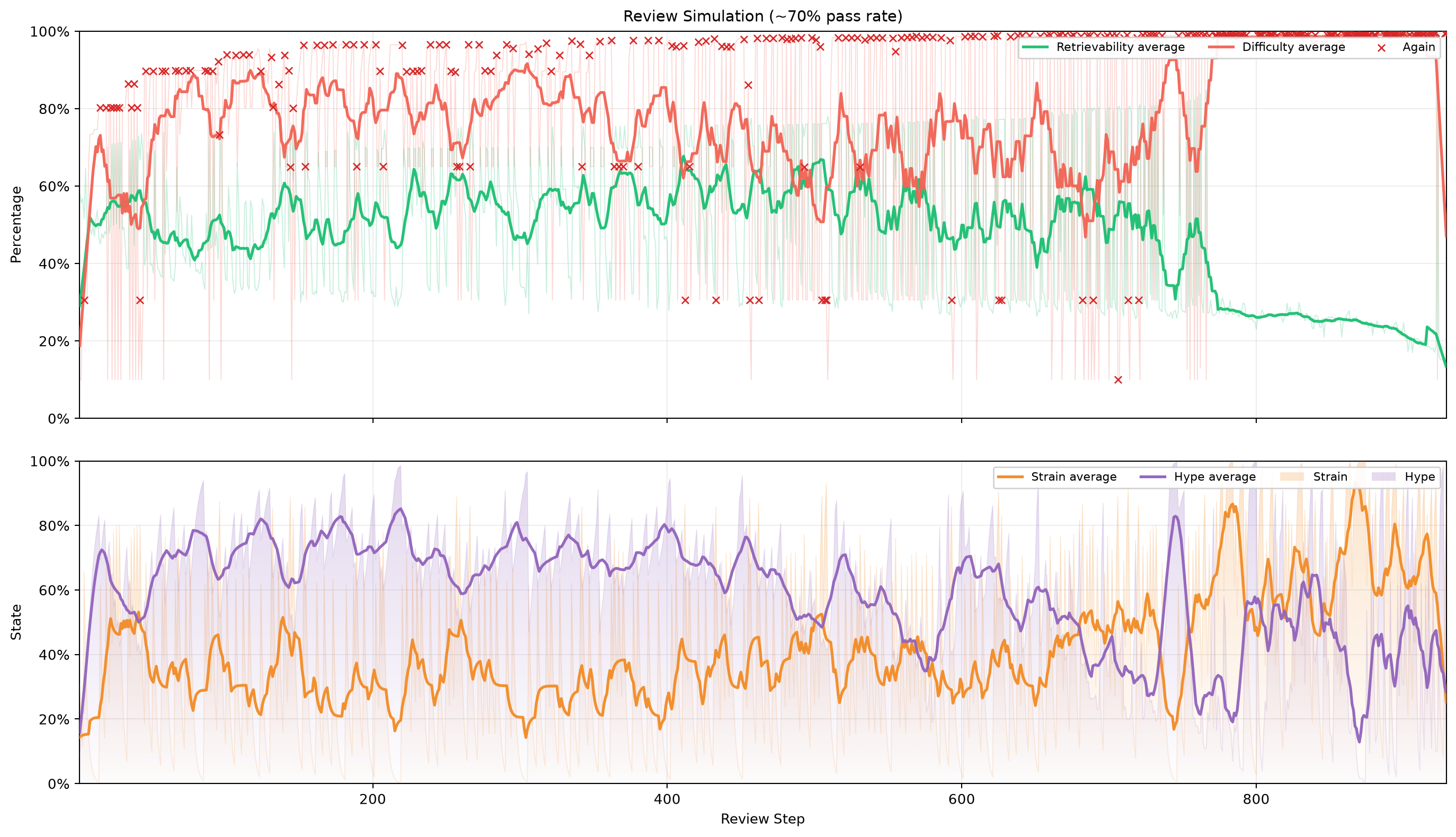
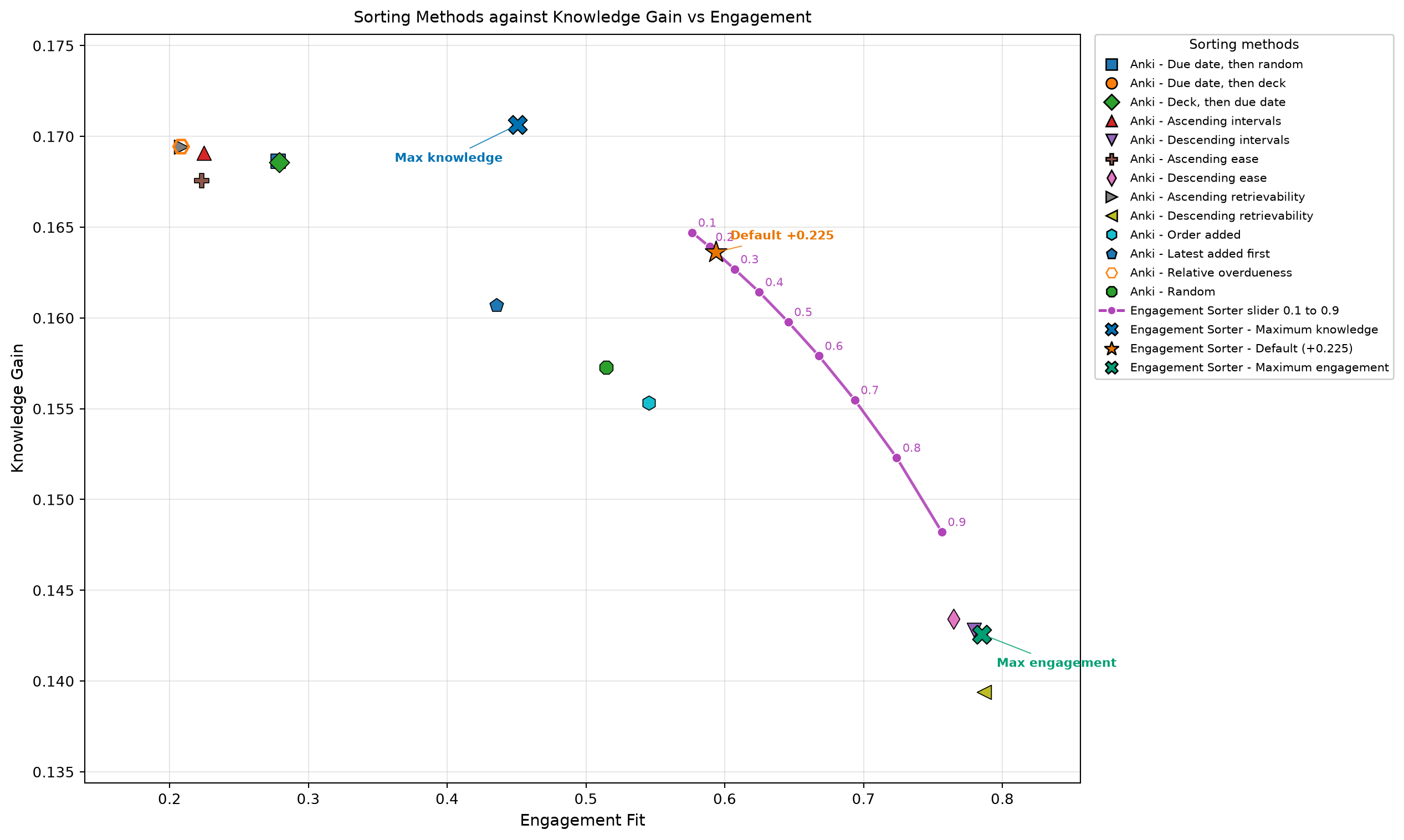
There is a tradeoff between knowledge gain and engagement. Focusing more on one can mean sacrificing some of the other, so the K/E ratio lets you tune that balance. We try to slog through as many important high knowledge valued cards as early as possible and fit in some momentum cards in-between when a user's strain gets high, to decrease it back and hopefully keep the momentum going.
$E=\sqrt{T}=\sqrt{r(1-d)}$
Higher retrievability (r) and lower difficulty (d) means easier to gain momentum from.
$M=(1-r)^{1-σ}r^σ$
When you fail a card, strain (σ) increases. Whereas passing a card, strain decreases. High strain will tend to easier cards to reduce strain. Low strain will tend to harder cards taking advantage of the low strain.
Hype is based on hated cards. If a user passes a card they hate, that signals euphoria and hype goes up. Each card holds a euphoric potential that determines the hype's impact (A). Hype begets more hype. So while a user is hyped up, we try to see if they can continue to take advantage of the hype and go through even more hated cards in hopes of hitting euphoria when passing it.
$H'=1-(1-H)e^{-A}$
Hype will decrease when failing euphoric potential cards.
$H'=He^{-A}$
You can configure the K/E ratio to make it more engaging or towards more knowledge gain.